
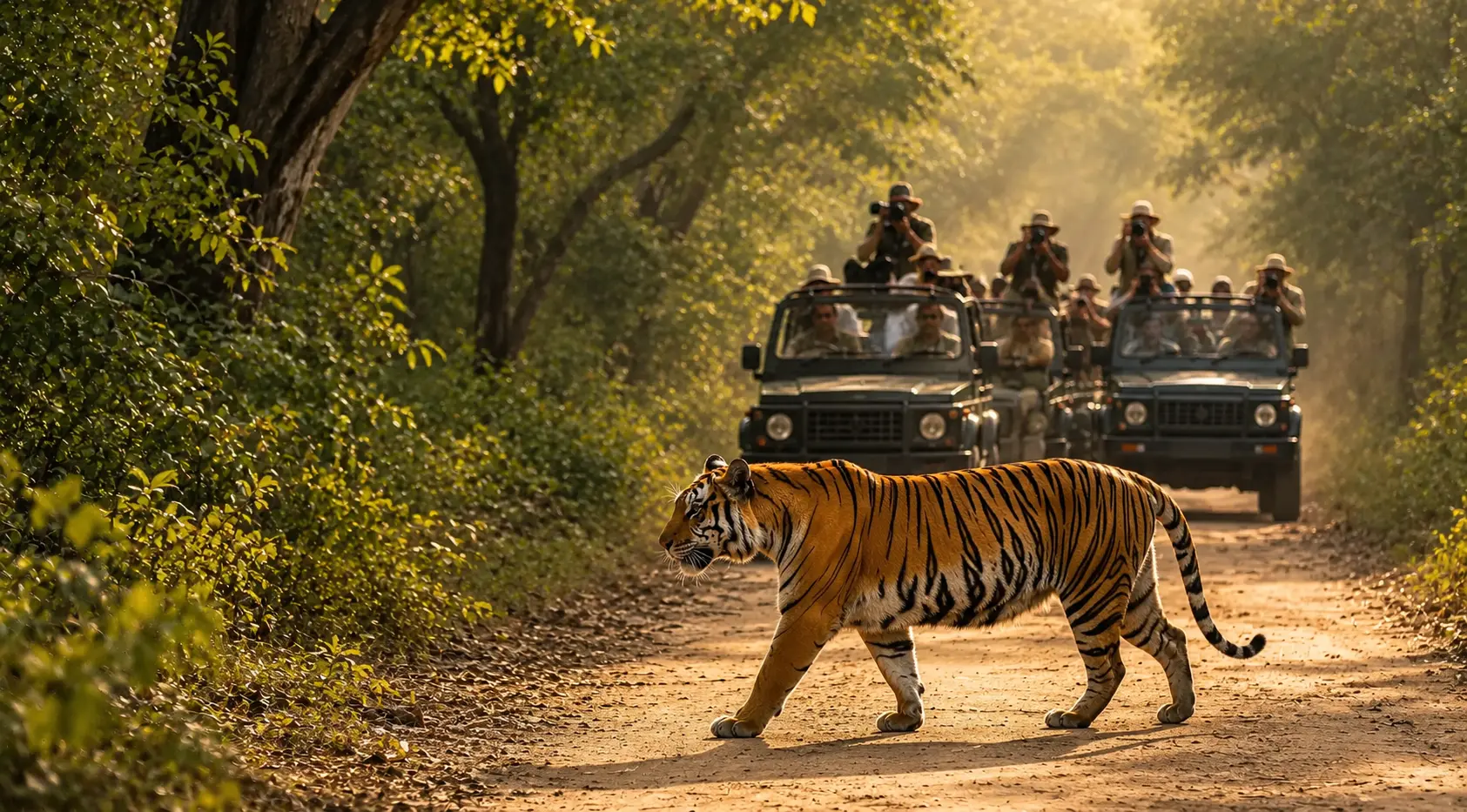
Rajaji National Park Safari Booking
Plan your Rajaji National Park safari with updated details on online booking, ticket prices, safari timings and entry rules. Compare Chilla, Motichur, Ranipur, Mohand, Jhilmil and Gohri safari zones, choose the right jeep safari experience, and get booking assistance for your preferred date and time slot.
What is Rajaji National Park?
Established in 1983 by merging three former wildlife sanctuaries - Rajaji, Motichur, and Chilla - the park was declared India's 48th Tiger Reserve in 2015 under the Government of India's Project Tiger programme. The reserve has a core zone of about 397 sq km and a buffer zone of about 423 sq km.
The park is named after C. Rajagopalachari, the first Indian Governor-General of India and a leader of the independence movement. The Ganga, Song, Rawasan, and Suswa rivers flow through it, creating riverine habitats within the Sal and Teak forests of the Shivalik range.
Six safari zones - Chilla, Motichur, Ranipur, Mohand, Jhilmil, and Gohri - open each year on November 15 and close on June 15. Gohri Range stays open year-round. Chilla and Motichur slots fill within days of the season opening. See the best time to visit guide →
About Rajaji National Park - History
Rajaji National Park takes its name from Chakravarti Rajagopalachari - widely known as "Rajaji" - who served as India's last Governor-General before the country became a republic in 1950. He was the founder of the Swatantra Party and a recipient of the Bharat Ratna. The park was named in tribute to his legacy in the Indian independence movement.
The park was officially constituted on 29 November 1983 under the Wildlife Protection Act, 1972, by merging the Rajaji Wildlife Sanctuary (1948), Motichur Wildlife Sanctuary (1964), and Chilla Wildlife Sanctuary (1977) into a single contiguous forest corridor across the Shivalik landscape. In April 2015, the Union Government declared it India's 48th Tiger Reserve under Project Tiger. The reserve is managed by the Uttarakhand Forest Department, whose official portal is rajajitigerreserve.uk.gov.in.
The terrain spans the Shivalik range - the southernmost and youngest range of the outer Himalayas - at elevations from 302 to 1,000 metres. The landscape alternates between dense Sal (Shorea robusta) and Teak forests, seasonal grasslands, wetlands, and riverine belts along the Ganga, Song, Rawasan, and Suswa rivers. This diversity lets a wide range of species coexist within one reserve.
Rajaji is part of the larger Rajaji-Corbett Elephant Reserve, and its population of over 500 Asian elephants is one of the largest concentrations in northern India. The park is a critical corridor between the Himalayas and the terai, supporting seasonal wildlife movement between higher and lower altitudes.
What is Rajaji National Park Famous For?
Is Rajaji the First National Park in India?
In Which State is Rajaji National Park?
For wildlife lovers, this makes Rajaji a rare combination: the accessibility of a park near major towns, with the density of a serious tiger and elephant reserve. Most visitors come specifically to see wild elephant herds and to try for a Bengal tiger sighting in the Chilla zone.
Rajaji Tiger Reserve - India's 48th Tiger Reserve
The reserve is managed by the Uttarakhand Forest Department and forms the western limit of the tiger's range in the Shivalik-Terai landscape. Conservation efforts here have focused on connecting Rajaji's tiger population with the larger Corbett population to the east, strengthening the genetic corridor across the two reserves.
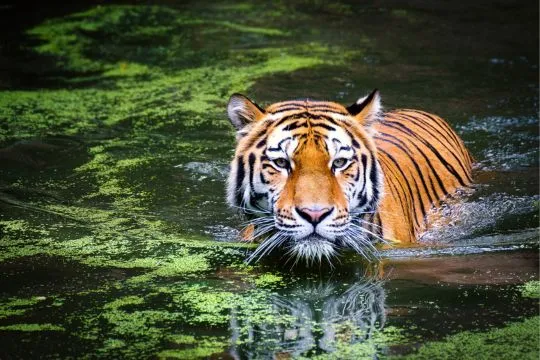
Tigers in Rajaji concentrate near the Ganga, Song, and seasonal water sources, especially in the dry winter and summer months. This is why morning safaris in Chilla zone offer the best tiger-sighting chances - animals move to water before the day heats up. The reserve also shelters 250+ leopards, with the highest leopard sighting rate in the Ranipur zone.
Alongside its big cats, Rajaji Tiger Reserve safeguards a complete Shivalik ecosystem: Asian elephants, sambhar, spotted deer, wild boar, the rare Barasingha swamp deer in Jhilmil, gharials along the Ganga, and 315+ bird species.

| Rajaji Tiger Reserve - Key Facts | Detail |
|---|---|
| Tiger Reserve designation | India's 48th (April 2015, Project Tiger) |
| Total area | 820 sq km |
| Core / critical tiger habitat | ~397 sq km |
| Buffer zone | ~423 sq km |
| Estimated Bengal tigers | 50+ |
| Best tiger zone | Chilla (highest sighting rate) |
| Managed by | Uttarakhand Forest Department |
How Far is Rajaji National Park? Distances & Travel Time
| From | To (Chilla Gate) | Approx. Distance | Travel Time |
|---|---|---|---|
| Haridwar | Rajaji National Park | 8 km | 15-20 min |
| Rishikesh | Rajaji National Park | 20 km | 25-30 min |
| Rishikesh | Mohand Zone | 12 km | 20 min |
| Dehradun (Jolly Grant Airport) | Rajaji National Park | 35 km | 50-60 min |
| Dehradun City | Rajaji National Park | 50 km | 1.5 hrs |
| Kotdwar | Gohri Zone | 10 km | 20 min |
| Delhi | Rajaji National Park | 230 km | 4.5-5 hrs (NH-334) |
Most visitors base themselves in Haridwar, Rishikesh or Dehradun and do a morning safari as a half-day trip, returning by noon - no overnight stay is needed. See full directions by air, train, and road →
Rajaji National Park Map - Safari Zones & Gates
The map below shows all six safari zones of Rajaji National Park and their gates relative to Haridwar, Rishikesh, and Dehradun. Chilla and Motichur sit closest to Haridwar; Mohand is nearest Rishikesh and Dehradun; Gohri lies toward Kotdwar.

View Rajaji National Park Ticket Price, Entry Fee and Jeep Safari Charges
Rajaji National Park Photos - Wildlife Gallery
Real wildlife photographed in Rajaji National Park's safari zones - elephants, tigers, leopards, deer and birds in their natural Shivalik habitat.


Why Visit Rajaji National Park?
Rajaji National Park is India's most accessible Tiger Reserve. It sits under 30 km from Haridwar and under 60 km from Rishikesh - you can do a morning safari and be back at your hotel by noon, with no overnight stay required.
The park hosts 50+ Bengal tigers and 500+ Asian elephants in one connected Shivalik forest. Tiger sightings in Chilla zone rank among the most consistent in North India. Unlike Corbett or Ranthambore, Rajaji stays far less crowded, so you experience the forest in near silence.
Six distinct safari zones mean you choose your experience: Chilla for tigers, Ranipur for leopards, Mohand for birds, or Jhilmil for the rare Barasingha deer. Each zone is a different ecosystem within the same reserve.
The 2026-27 season runs November 15 to June 15. The forest department caps daily vehicle quotas per zone. Book early - slots go fast.
What Visitors Say
Safari Zones in Rajaji National Park - Choose Your Experience
Each zone has a different landscape, wildlife, and character. Here is a quick guide to picking the right one for your trip.
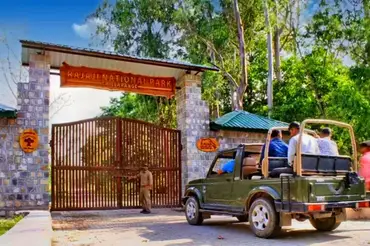
Chilla Safari Zone
Chilla Range is Rajaji's primary tiger zone near Haridwar. It covers the largest core habitat and records the highest tiger and elephant sighting rates in the park. The Ganga forms its eastern boundary. Open Nov 15-Jun 15. Safari: 2.5-3 hours.
Explore Chilla Safari →
Mohand Safari Zone
Mohand Range is 12 km from Rishikesh and one of North India's finest birdwatching zones, with 200+ species recorded. The terrain is more open here, ideal for wildlife photography. Safari covers 25-30 km over 2-2.5 hours.
Explore Mohand Safari →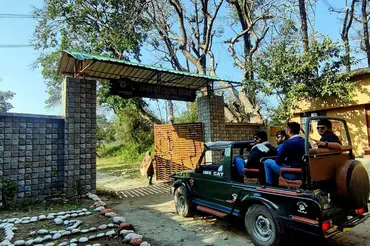
Ranipur Safari Zone
Ranipur Range has the highest leopard sighting rate in Rajaji. The rocky Shivalik terrain is ideal leopard habitat. Expect spotted deer, sambhar, nilgai, barking deer, and owls alongside leopards. Route: about 25 km.
Explore Ranipur Safari →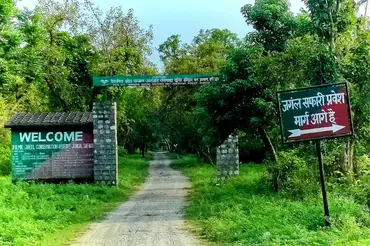
Jhilmil Safari Zone
Jhilmil Jheel is the only wetland conservation zone in Rajaji and the last habitat in Uttarakhand for the endangered Barasingha (swamp deer). This buffer zone is also a key birdwatching area for migratory species. Best at early morning or late afternoon.
Explore Jhilmil Safari →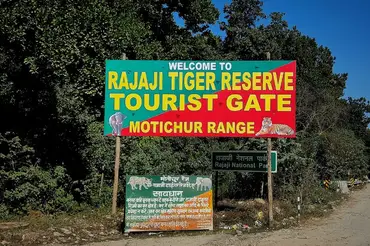
Motichur Safari Zone
Motichur Range sits 9 km from Haridwar on the Haridwar-Rishikesh highway. One of the three original sanctuaries merged into the park, it is ideal for families - dense Sal forest with frequent elephant sightings along a 24 km route.
Explore Motichur Safari →
Gohri Safari Zone
Gohri Range is the only zone in Rajaji that stays open year-round, including monsoon. Located near Kotdwar on the Song River in Pauri Garhwal district, it offers tigers, elephants, and diverse birdlife in a less-visited setting.
Explore Gohri Safari →Flora and Fauna of Rajaji National Park
Rajaji Tiger Reserve supports one of India's richest Shivalik ecosystems. Read the complete flora and fauna guide →
Flora of Rajaji National Park
Rajaji's forests grow Sal (Shorea robusta), Teak, Semal, Rohini, and Khair trees, providing food and shelter for many birds and mammals. Dense bamboo and riverine vegetation line the Ganga and Song rivers within the park boundary.
Grasslands cover large sections, feeding elephant herds and deer and serving as hunting grounds for tigers and leopards. Many native medicinal plants used in Ayurveda grow undisturbed through the forest floor of this Shivalik ecosystem.
Wildlife of Rajaji National Park
The park shelters 50+ Bengal tigers, 500+ Asian elephants, and 250+ leopards. On safari you may spot spotted deer, sambhar, barking deer, wild boar, swamp deer (Barasingha), and Himalayan goral.
Over 315 bird species have been documented - including Great Hornbill, Pied Hornbill, Pallas's Fish Eagle, and several kingfishers. Reptiles include king cobras, Indian pythons, monitor lizards, and the critically endangered gharial along the Ganga corridor.
Rajaji National Park Safari Timings 2026-27
Safari timings follow sunrise and sunset. Below are the 2026-27 morning and evening slots across all zones.
Morning Safari
| Season | Timing |
|---|---|
| November - February | 6:00 AM - 9:30 AM |
| March - June | 5:30 AM - 9:00 AM |
Evening Safari
| Season | Timing |
|---|---|
| November - February | 2:30 PM - 5:30 PM |
| March - June | 3:00 PM - 6:00 PM |
Rajaji National Park Ticket Price & Entry Fee 2026-27
The prices below are published on this website for the 2026–27 season. Safari tariffs, gate operations and availability can change, so confirm the final payable amount before travel.
Per Person Entry Fee
| Category | Fee |
|---|---|
| Indian Adults | ₹150 |
| Indian Children (5-12 yrs) | ₹75 |
| Children below 5 years | Free |
| Foreign Nationals | ₹600 |
| Foreign Children | ₹300 |
Jeep Safari Charges (Per Vehicle)
| Item | Cost |
|---|---|
| Private Jeep (up to 6 pax) | ₹3,000 |
| Mandatory Naturalist / Guide | ₹1,000 |
| Shared Jeep Safari | ₹950 / person |
| Video Camera Permit | ₹1,500 |
| Binoculars (Optional) | ₹800 |
Rajaji National Park Jeep Safari Charges - Cost Per Person
Rajaji National Park Safari Packages 2026
Every safari package includes the forest department permit, an authorised open-top gypsy jeep, a certified naturalist guide, and gate assistance. Choose by group size and goal - all packages can be booked by phone or WhatsApp in minutes.
| Package | Best For | Includes | Indicative Cost |
|---|---|---|---|
| Shared Jeep Safari | Solo travelers & couples | Seat in shared gypsy + permit + naturalist | ₹950 / person + entry |
| Private Jeep Safari | Families & groups up to 6 | Exclusive gypsy + permit + naturalist | ₹3,000 + ₹1,000 guide + entry |
| Tiger Special - Chilla | Tiger & elephant seekers | Morning Chilla slot + expert tracker | From ₹4,150 / jeep |
| Birdwatching - Mohand | Birders & photographers | Mohand safari + birding specialist guide | From ₹4,150 / jeep |
| Full-Day Wildlife Package | Photographers & enthusiasts | Morning + evening safari, two zones | On request |
| Safari + Hotel Pickup | Guests in Haridwar / Rishikesh / Dehradun | Safari + return transfer from your hotel | On request |
Group larger than 6? Two jeeps travel together on the same route so nobody misses a sighting. Call +91 99176 06031 or WhatsApp us for exact package pricing and same-day availability. See detailed packages →
Rajaji National Park Safari Booking Office & Online Booking
Online Booking vs Gate Booking - Which is Better?
Online (portal) booking secures your permit, but you still have to hire the gypsy jeep and naturalist separately at the gate - many visitors are surprised by this and end up paying jeep rent on the spot. Gate booking works in off-peak months (April-June) but Chilla and Motichur counters routinely sell out in peak season.
Operator booking is the most convenient route: one call confirms the permit, jeep, and certified guide together, at forest-department rates plus service. This is why most families, photographers, and foreign visitors book through a local operator.
Documents Needed for Safari Booking
Every visitor's full name, age, and government ID number must be entered on the permit. Indian nationals need Aadhaar, Voter ID, or Driving Licence; foreign tourists need a passport number. Carry the same physical ID to the gate - it is checked before entry.
During peak season (November-February), book at least 7 days in advance. For same-day plans, call +91 99176 06031 - we confirm live availability across all six zones.
How to Book Rajaji National Park Safari Online
Booking takes under 10 minutes. Follow these five steps to confirm your safari slot in advance.
Pick a Safari Zone
Choose by goal - tigers (Chilla), leopards (Ranipur), birds (Mohand), or family (Motichur). Compare all zones →
Choose Safari Type
Select a private jeep (up to 6 passengers) for a personal experience, or a shared jeep if travelling solo or as a couple.
Book Online or Call
Visit our site or call +91 99176 06031 for instant booking. WhatsApp also works for quick confirmation.
Pick Your Date
Book at least 7 days ahead in peak season (Nov-Feb). Chilla and Motichur morning slots go first - don't wait.
Fill Visitor Details
Enter names, age, and ID proof. Indians need Aadhaar or Voter ID; foreign tourists need a passport number.
Elephant Safari in Rajaji National Park
Elephant safaris returned to Rajaji's Chilla zone in December 2025 after a seven-year gap - and Chilla is currently the only zone offering them. Riding an elephant through the dense Sal forest gives a quiet, elevated view no jeep can match.
From an elephant's back you spot spotted deer, leopards, wild boar, and birds at close range. The slow pace lets wildlife settle around you - animals are far less startled by an elephant than by a jeep engine.
Elephant safaris also support Rajaji's conservation program. Slots per day are limited and fees are set by the forest department, so book the morning slot and call ahead to confirm availability. Read about elephant safaris →
.jpg)
Jungle Safari in Rishikesh - Rajaji National Park
Looking for a jungle safari in Rishikesh? Rajaji National Park is just 20 km away. A taxi reaches Chilla Gate in 25-30 minutes via the Haridwar-Rishikesh highway, so a morning safari fits comfortably into a Rishikesh day trip.
The Mohand zone lies even closer - only 12 km from Rishikesh - and is one of North India's best birdwatching spots, with 200+ species recorded in this stretch of Shivalik forest. Wildlife photographers visit Mohand for its avian diversity.
From Rishikesh you can also reach Motichur zone in under 30 minutes - known for elephant sightings and a popular family choice. Explore Mohand Safari →
Jungle Safari in Haridwar - Chilla Zone Entry
For a jungle safari in Haridwar, the Chilla zone of Rajaji National Park sits just 8 km from the city - the closest park entry to any major town in Uttarakhand. An auto-rickshaw reaches the gate in about 15 minutes; a taxi costs ₹300-₹400.
Chilla covers the largest core tiger habitat in Rajaji and consistently records the highest tiger and elephant sighting rates across all six zones. Most returning guests choose Chilla on every visit.
Motichur zone - also close to Haridwar at 9 km - is ideal for families. It sits on the Haridwar-Rishikesh highway with dense Sal forest and frequent elephant sightings. Book Chilla Safari →


Jungle Safari in Dehradun - Rajaji National Park Mohand Zone
Rajaji National Park is the closest jungle safari to Dehradun. The Mohand zone sits on the Dehradun-Saharanpur road, and the Chilla gate is about 35 km from Jolly Grant Airport - roughly 50-60 minutes by taxi.
Guests staying in Dehradun city usually pick Mohand for a birdwatching-focused morning, or drive 50 km to Chilla for the highest tiger and elephant sighting probability. Either way, the safari fits into a half-day plan with time to spare.
Flying in? Land at Jolly Grant, do a morning safari, and continue to Rishikesh or Mussoorie by afternoon - a route many of our guests follow. See directions from Dehradun →
How to Reach Rajaji National Park from Haridwar, Rishikesh & Dehradun
By Air
Jolly Grant Airport in Dehradun is the nearest airport - about 35 km from Chilla Gate. Delhi-Dehradun flights take under an hour. A taxi to the gate costs around ₹1,200-₹1,500.
By Train
Haridwar Railway Station is 8 km from Chilla Gate. Shatabdi, Jan Shatabdi, and Mussoorie Express trains run daily from Delhi (4-5 hours). Check schedules at irctc.co.in.
By Road
Rajaji National Park is 230 km from Delhi via NH-334 - about a 4.5 to 5-hour drive. Buses and shared taxis run regularly from Delhi, Rishikesh, Dehradun, and Haridwar to the park gates.
Chilla Gate - From Haridwar
Chilla Gate is 8 km from Haridwar city. Take an auto-rickshaw (₹80-₹120) or taxi (₹300-₹400). The gate opens at 6:00 AM for morning safaris - arrive 15 minutes early with your printed permit.
Safari Tips for Rajaji National Park
Follow these tips for a safe, rewarding wildlife experience. Your guide covers these on arrival, but knowing them in advance helps you prepare.
Meet Veeru Negi - Expert Safari Guide at Rajaji National Park

Veeru Negi - Wildlife Naturalist
Veeru Negi has led safaris in Rajaji National Park for over 15 years. He grew up near the park and has explored every trail, riverbank, and forest track in the reserve.
View Full Profile & AwardsWhy Guests Choose Veeru Negi
1. Deep Local Knowledge
- 15+ years guiding in Rajaji National Park - knows seasonal animal movements by heart.
- Led thousands of safaris for families, solo travelers, researchers, and professional photographers.
- His sighting rate in Chilla zone is among the highest of any guide in Rajaji.
2. Expert Wildlife Tracking
- Reads animal tracks, pugmarks, and alarm calls that most visitors overlook.
- Specialises in locating tigers and elephants near Ganga-side water sources on morning safaris.
- Expert birdwatcher - identifies birds by call alone during Mohand zone tours.
3. Safety and Certified Service
- Holds all Uttarakhand Forest Department certifications for wildlife guiding and first aid.
- Adapts each safari to the group - families, photographers, or nature lovers.
- 5-star rated by guests - praised for patience, knowledge, and warmth.
राजाजी नेशनल पार्क (राजाजी राष्ट्रीय उद्यान) - एक नज़र में
यह पार्क सन् 1983 में बना और 2015 में इसे प्रोजेक्ट टाइगर के तहत भारत का 48वां टाइगर रिज़र्व घोषित किया गया। इसका नाम भारत के पहले भारतीय गवर्नर-जनरल सी. राजगोपालाचारी (राजाजी) के नाम पर रखा गया है।
टिकट और सफारी शुल्क: भारतीय वयस्कों के लिए प्रवेश शुल्क ₹150, प्राइवेट जिप्सी जीप ₹3,000 (6 लोगों तक) + गाइड ₹1,000, और शेयर्ड जीप ₹950 प्रति व्यक्ति है।
सफारी सीज़न: 15 नवंबर से 15 जून तक। गोहरी रेंज पूरे साल खुली रहती है। चिल्ला ज़ोन टाइगर और हाथी देखने के लिए सबसे अच्छा है। पार्क हरिद्वार से सिर्फ़ 8 किमी और ऋषिकेश से 20 किमी दूर है। बुकिंग के लिए कॉल करें: +91 99176 06031।
Rajaji National Park - Safari Guides & Resources
Delhi to Rajaji Now 2.5 Hours: The Expressway That Flies Over a Tiger Reserve
Not a story about a highway damaging a forest - the opposite. A case study in infrastructure designed around wildlife.
Read More →Elephant Safaris Are Back at Rajaji After 7 Years
In December 2025, something changed deep inside Rajaji Tiger Reserve's Chilla zone.
Read More →5 Things Nobody Tells You About Rajaji Safari
Insider tips that go deeper than the basics - and will change how you plan your visit.
Read More →Why February is the Best Month for Rajaji Safari 2026
Dry conditions, excellent visibility, and peak animal activity near water sources.
Read Full →Tiger Sighting Update - Rajaji National Park 2026
Latest tiger activity in Chilla Range with the best locations, timing, and sighting patterns.
Read More →Chilla vs. Motichur: Which Zone is Best for You?
A zone-by-zone comparison - wildlife, terrain, crowds, and sighting probability.
Read Guide →Watch Rajaji National Park Wildlife Videos
Frequently Asked Questions - Rajaji National Park
Book Your Rajaji National Park Safari Today
Rajaji National Park is open from November 15 to June 15. India's 48th Tiger Reserve sits under 30 km from Haridwar and under 60 km from Rishikesh - far less crowded than Jim Corbett or Ranthambore, with equally strong tiger and elephant sightings.
Chilla zone slots fill within days of the season opening. Book your morning safari at least a week in advance, arrive 15 minutes early with your printed permit, and let the jungle do the rest.