
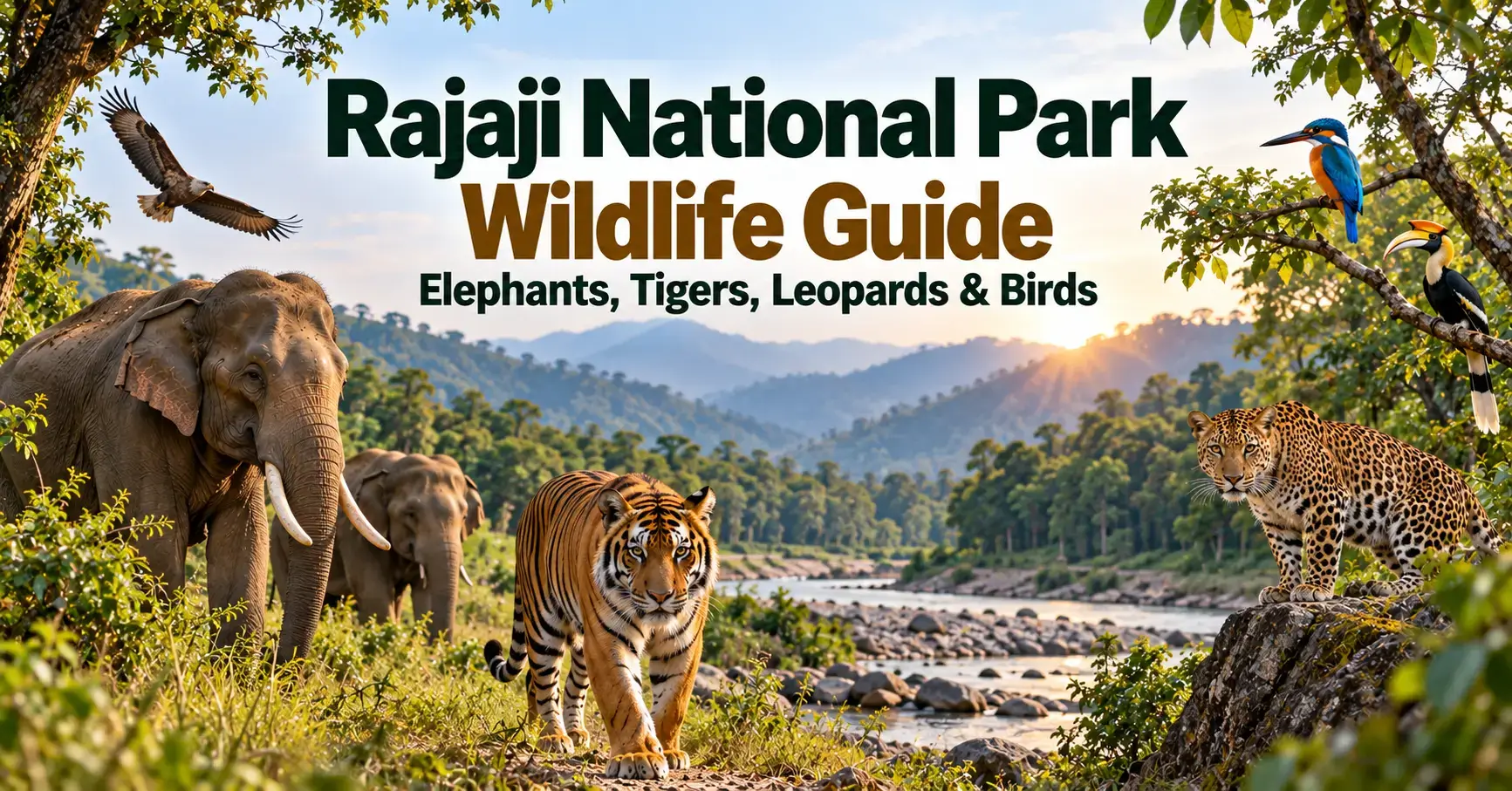
Rajaji National Park protects one of the richest Shivalik ecosystems in India — over 500 Asian elephants, 50+ Bengal tigers, 250+ leopards, and more than 315 recorded bird species, alongside reptiles, deer, and smaller mammals across its six safari zones. This guide covers what lives here, where each species is most commonly spotted, and what makes Rajaji’s wildlife significant beyond the basic sighting checklist.
Asian Elephants — Rajaji’s Signature Species
Rajaji is home to more than 500 Asian elephants, one of the largest concentrations found anywhere in northern India. The park forms a critical part of the Rajaji-Corbett Elephant Reserve, a landscape-level conservation corridor that connects Rajaji’s forests with Corbett’s to the east, allowing elephant herds to move between the two reserves seasonally in search of food and water.
This corridor function matters conservation-wise: elephants need far larger ranging areas than a single park can typically provide, and the connectivity between Rajaji and Corbett is one of the reasons this elephant population remains genetically healthy and viable long-term, rather than isolated.
Where to see elephants: Motichur zone is particularly known for frequent elephant sightings in its dense Sal forest, making it a strong choice for families. Chilla zone also records high elephant sighting rates alongside its tiger sightings. As of December 2025, Chilla is also the only zone offering an elephant safari in Rajaji National Park — riding an elephant through the forest rather than a jeep, which gives a quieter, closer wildlife experience since animals are less startled by an elephant’s presence than a jeep engine.
Bengal Tigers
Rajaji shelters an estimated 50+ Bengal tigers, protected as India’s 48th Tiger Reserve since April 2015. While this is a modest population compared to Corbett’s 260+, tiger sightings in Rajaji are genuinely achievable, particularly in Chilla zone, which covers the park’s largest core tiger habitat along the Ganga’s eastern boundary.
Tigers in Rajaji concentrate near the Ganga, Song, and seasonal water sources, especially during the dry winter and summer months when water is scarcer elsewhere in the forest. This is why morning safaris consistently outperform evening ones for tiger sightings — animals move toward water sources before the day’s heat sets in, making the first two hours after sunrise the highest-probability window.
Leopards
Rajaji protects over 250 leopards — a population that actually exceeds its tiger count, though leopards are naturally more elusive and harder to spot due to their solitary, often nocturnal behavior. Ranipur zone has Rajaji’s highest leopard sighting rate, thanks to its rocky Shivalik terrain, which is ideal leopard habitat. Alongside leopards, Ranipur safaris commonly turn up spotted deer, sambhar, nilgai, and barking deer.
Deer Species
Rajaji hosts several deer species across its zones:
- Spotted deer (chital) — widespread across most zones, often the first wildlife visitors see
- Sambhar — larger deer found in denser forest sections
- Barking deer — smaller, found in more secluded forest patches
- Swamp deer (Barasingha) — found only in Jhilmil zone, and critically, this is the last habitat for Barasingha in all of Uttarakhand, making Jhilmil ecologically significant well beyond its safari appeal
Birds — 315+ Recorded Species
Rajaji’s bird diversity is genuinely exceptional for a tiger reserve, with over 315 species documented, including the Great Hornbill, Pied Hornbill, Pallas’s Fish Eagle, and multiple kingfisher species. Mohand zone is the standout for birding, with 200+ species recorded in this one stretch of Shivalik forest alone — a figure that puts it among North India’s better dedicated birding destinations, not just an add-on to a tiger safari.
Jhilmil zone, as a wetland conservation area, is also significant for migratory birds, particularly in early morning and late afternoon when wetland species are most active.
Reptiles
Rajaji’s reptile life includes king cobras, Indian pythons, and monitor lizards across its forest zones. Along the Ganga corridor, the park also shelters the critically endangered gharial — a fish-eating crocodilian distinguished by its long, narrow snout, now one of the rarest crocodilian species in the world. Gharial sightings are opportunistic rather than guaranteed, typically along river-adjacent stretches of the safari route.
Other Mammals
Beyond the headline species, Rajaji supports wild boar, the Himalayan goral (a goat-antelope found on rocky slopes), langurs, and golden jackals. These are commonly spotted across most zones and often provide the “in-between” sightings on a safari focused primarily on tigers or elephants.
Which Zone for Which Animal — Quick Reference
| Animal | Best Zone |
|---|---|
| Tigers | Chilla |
| Elephants | Motichur, Chilla |
| Leopards | Ranipur |
| Birds (general) | Mohand |
| Swamp deer (Barasingha) | Jhilmil |
| Migratory wetland birds | Jhilmil |
| Gharials | Chilla (Ganga-adjacent stretches) |
| Wildlife in monsoon season | Gohri (only zone open year-round) |
Best Time of Day for Wildlife Sightings
Morning safaris consistently outperform evening ones across nearly every species in Rajaji, not just tigers. Animals are most active in the first two hours after sunrise, moving toward water sources before temperatures rise, and the forest is generally quieter and less disturbed early in the day. If you can only book one safari slot, choose morning over evening.
Conservation Significance
Rajaji’s wildlife matters beyond the safari experience. Its elephant population is part of a genetically critical corridor connecting to Corbett; Jhilmil’s Barasingha population is the last of its kind in Uttarakhand; and its gharial population contributes to one of the world’s most endangered crocodilian species. Choosing a responsible operator, staying quiet during safaris, and never approaching or feeding wildlife all directly support the conservation work happening in this reserve.
Conclusion
Rajaji National Park’s wildlife goes well beyond the tiger-and-elephant headline — it’s a genuinely diverse Shivalik ecosystem supporting one of India’s most significant elephant corridors, a real (if smaller) tiger population, the highest leopard density in the region, exceptional birdlife, and the last remaining Barasingha habitat in Uttarakhand. Matching your zone choice to the species you most want to see — Chilla for tigers and elephants, Ranipur for leopards, Mohand for birds, Jhilmil for swamp deer and wetland birds — is the single most important decision for a satisfying wildlife trip here.
Frequently Asked Questions
What animals can I see in Rajaji National Park?
Rajaji is home to 500+ Asian elephants, 50+ Bengal tigers, 250+ leopards, spotted deer, sambhar, barking deer, swamp deer (Barasingha), wild boar, Himalayan goral, and langurs, along with over 315 bird species and reptiles including king cobras, pythons, monitor lizards, and gharials.
How many elephants are in Rajaji National Park?
Rajaji is home to more than 500 Asian elephants, one of the largest concentrations in northern India, and forms part of the Rajaji-Corbett Elephant Reserve corridor.
Which zone has the most leopards in Rajaji?
Ranipur zone has the highest leopard sighting rate in Rajaji National Park, due to its rocky Shivalik terrain that suits leopard habitat.
Are there crocodiles in Rajaji National Park?
Yes, the critically endangered gharial — a narrow-snouted, fish-eating crocodilian — is found along the Ganga corridor within Rajaji’s boundary, though sightings are opportunistic rather than guaranteed.
What birds can I see in Rajaji National Park?
Over 315 bird species have been recorded, including the Great Hornbill, Pied Hornbill, Pallas’s Fish Eagle, and several kingfisher species. Mohand zone alone has 200+ recorded species, making it Rajaji’s top birding destination.
Is Rajaji known for its elephant corridor?
Yes. Rajaji is a key part of the Rajaji-Corbett Elephant Reserve, a landscape-level corridor that allows elephant herds to move seasonally between the two reserves, supporting the long-term genetic health of the population.