
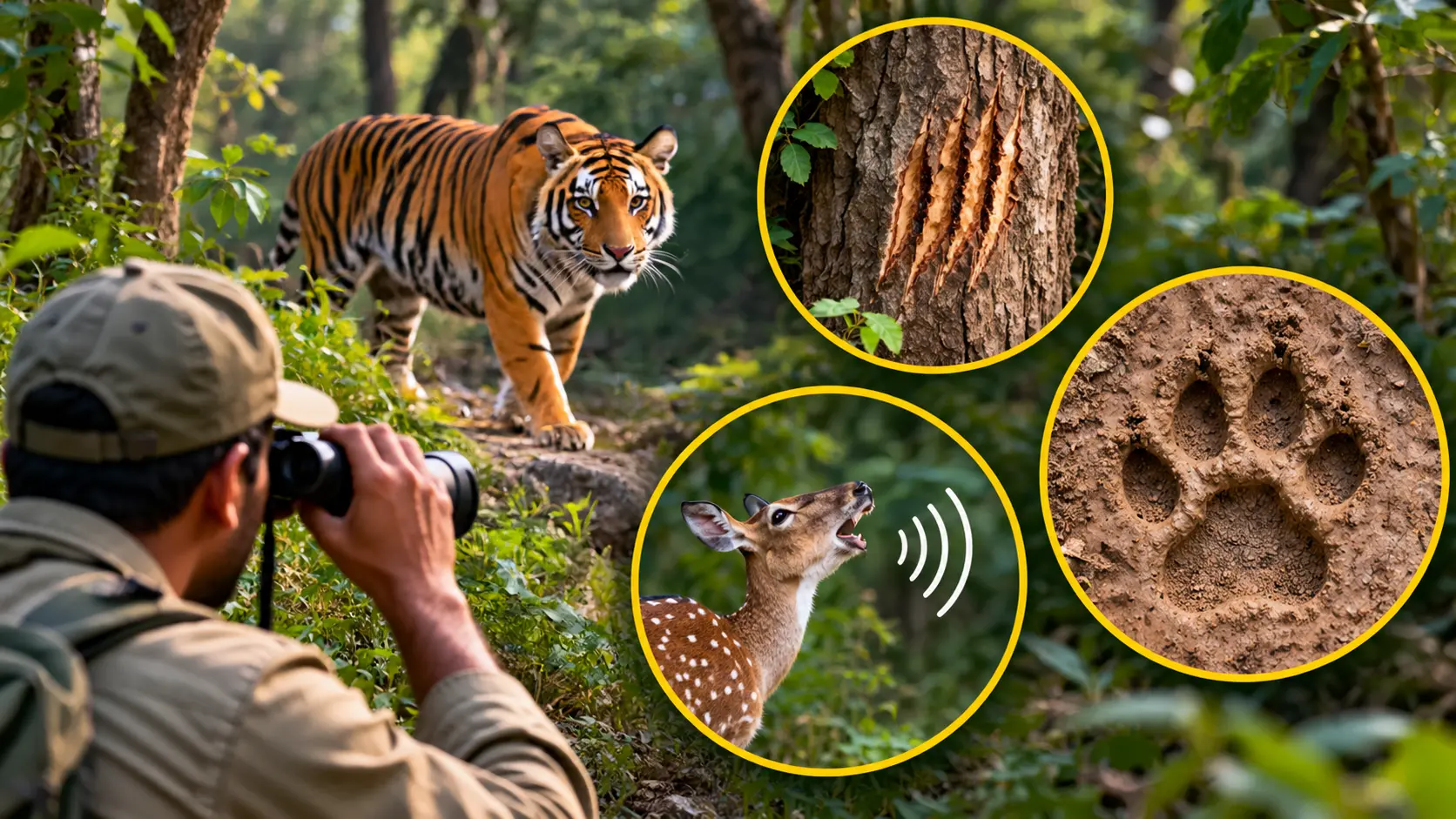
Every visitor to a tiger reserve hopes for the same moment, a striped shape stepping out of the grass into the open. If you want to know how to spot a tiger in Rajaji National Park, the honest answer is that it takes knowledge, patience and a little luck. Tigers are masters of camouflage and often rest in thick cover, yet experienced naturalists find them again and again by reading the forest instead of simply driving through it.
Rajaji National Park is India’s 48th Tiger Reserve and covers 820 sq km across Haridwar, Dehradun and Pauri Garhwal districts of Uttarakhand. It shelters an estimated 50+ Bengal tigers alongside 500+ Asian elephants and 250+ leopards. The Chilla gate is only 8 km from Haridwar, so a morning of tracking fits easily into a short trip.
This guide explains what a tiger sighting in Rajaji National Park really looks like, the best zone for tiger safari, the right time of day, and how to use tiger pugmarks and alarm calls to follow a tiger without ever leaving the jeep. It is written for first-time visitors and for photographers who want to improve their odds.
Tiger Sighting in Rajaji National Park and What to Expect Realistically
A tiger sighting in Rajaji National Park is exciting because the park is quieter and less crowded than many famous reserves. Dense Sal forest, tall grass, dry riverbeds and ridgelines give tigers plenty of cover, so sightings are often brief. You may see a tiger crossing a track, resting near water or walking along a riverbank for a few minutes.
No guide, operator or website can guarantee a tiger. Wild animals follow their own routines, and the forest is large. What you can control is your preparation, your timing and your choice of zone and guide. Visitors who prepare well and stay patient are the ones who go home with a story.
What Are the Chances of Seeing a Tiger in Rajaji National Park?
Short answer. The chances are real but never guaranteed. Tigers are present across the reserve, and the Chilla zone records the highest tiger and elephant sighting rates in the park. Your chances improve with morning safaris, the dry months, an experienced naturalist and more than one safari.
Several factors affect how to spot a tiger in Rajaji National Park, and each one is within your control except luck.
- Zone. Chilla is the strongest option for tigers, as covered below.
- Season. Dry months push animals toward water, which makes them easier to find.
- Time of day. Early morning is the most productive window.
- Guide skill. A naturalist who reads signs and calls finds animals that others drive past.
- Number of safaris. Two or three outings give far better odds than a single drive.
- Luck. Even the best planned safari depends on where the animal chooses to be.
Treat every safari as a chance to enjoy the full forest. Elephants, leopards, deer and birds make the trip rewarding even if the tiger stays hidden.
Which Zone Has the Most Tigers and What Is the Best Zone for Tiger Safari?
Short answer. Chilla is the best zone for tiger safari in Rajaji National Park. It covers the largest core habitat in the park, sits on the Ganga boundary and records the highest tiger sighting rate among the six zones.
Chilla Zone, the Top Choice for Tigers
Chilla lies near Haridwar and offers a mix of forest, riverbed and water sources. Tigers in Rajaji concentrate near the Ganga, the Song and seasonal water sources, especially in the dry winter and summer months. That makes Chilla the best zone for tiger safari for most visitors, and it is why many returning guests choose it on every trip.
Other Zones Worth Considering
Other zones can also produce tiger sightings, although less often. Motichur is close to Haridwar and good for elephants and families. Ranipur has the highest leopard sighting rate. Mohand is a top birding zone. Gohri, near Kotdwar, stays open year-round and is less visited. If your main goal is a tiger, pick Chilla for your first and second safaris, then add another zone for variety.
You can also read our comparison, Chilla vs Motichur, to decide between the two zones closest to Haridwar.
What Time Are Tigers Most Active?
Short answer. Tigers are most active around dawn and dusk, and they often move at night. On safari, the best window is the first two hours after sunrise, when animals move toward water before the heat rises.
If you are wondering how to spot a tiger in Rajaji National Park at the right hour, the answer is early. Tigers spend much of the day resting in shade and become more active as temperatures drop. That is why morning slots are strongly recommended. They run from 6:00 AM to 9:30 AM between November and February, and from 5:30 AM to 9:00 AM between March and June. Evening safaris run from 2:30 PM to 5:30 PM in winter and from 3:00 PM to 6:00 PM in summer, and they can also produce sightings, though less reliably.
Best Season for a Tiger Sighting in Rajaji National Park
The safari season runs from 15 November to 15 June. Within that window, the dry months are usually the best for anyone learning how to spot a tiger in Rajaji National Park.
- December and January. Tiger and elephant sightings peak, and cool weather keeps animals active for longer in the morning.
- February. Dry conditions, strong visibility and excellent activity near water.
- March to June. Heat pushes animals toward rivers and waterholes. Tigers often rest near water in the afternoon, which makes patient waiting rewarding.
Our best time to visit guide explains each month in more detail, and our blog on the latest tiger sightings shares recent patterns.
How to Spot a Tiger in Rajaji National Park Step by Step
Here is a simple method that experienced naturalists use. Follow these steps to improve your chances.
- Book a morning safari in Chilla. This is the most important decision. Choose the first slot of the day.
- Arrive early. Reach the gate at least 15 minutes before opening with your printed permit and ID.
- Stay quiet from the start. Sound travels far in the forest. Silence helps you hear alarm calls and keeps animals relaxed.
- Watch the water. Check riverbanks, streams and waterholes first, because tigers drink and rest nearby.
- Scan the ground. Look for fresh pugmarks, scrape marks and drag marks on dusty tracks.
- Listen for alarm calls. Deer, langur and peafowl often announce a tiger long before you see it.
- Wait patiently. When your guide hears an alarm call or finds fresh signs, stop and wait. Tigers often appear after several quiet minutes.
- Stay with your guide’s judgement. A good naturalist knows when to move and when to hold position.
This approach is the core of how to spot a tiger in Rajaji National Park, and it works in every season.
Tiger Pugmarks and Alarm Calls Explained
The two most useful clues on a jeep safari are tracks on the ground and calls in the air. Understanding tiger pugmarks and alarm calls turns a long drive into a purposeful hunt.
How to Read Tiger Pugmarks
A pugmark is a footprint. Fresh prints on sand, mud or dusty tracks reveal that a tiger passed recently and show which direction it was walking. Ask your guide to stop and examine tracks together.
| Feature | Tiger | Leopard |
| Size | Large, roughly the size of a hand | Noticeably smaller |
| Shape | Broad and rounded | Narrower and more oval |
| Toes | Four toes, no claw marks | Four toes, no claw marks |
| Heel pad | Large with three lobes at the base | Smaller and neater |
Cats keep their claws retracted when walking, so claw marks usually mean the animal is a dog or another species. Fresh pugmarks have sharp edges and may show crumbs of sand or moisture. Old prints look worn, with softened edges. Tiger pugmarks and alarm calls together are the two best clues for timing a sighting.
Other Signs a Tiger Has Passed
- Scrape marks. Tigers scratch the ground and leave long marks on tracks.
- Scat. Droppings with hair or bone fragments show recent presence.
- Scent marks. Tigers spray trees and rocks, and the strong smell can sometimes be noticed by your guide.
- Claw marks on trees. Tigers stretch and scratch trunks to mark territory.
- Drag marks and kill remains. A kill often draws tigers back, and circling vultures can point to it.
Understanding Alarm Calls
Prey animals warn each other when a predator is close. These calls are one of the most reliable cues for a tiger sighting in Rajaji National Park. Your naturalist will interpret them, but it helps to know the basics.
| Animal | Call | What It Often Means |
| Sambar | Loud, sharp, repeated bark | A large predator is nearby |
| Chital (spotted deer) | Short, sharp barks | A tiger or leopard has been sighted |
| Langur | Loud whoops and rapid calls | A predator is on the ground or moving close |
| Peafowl | Repeated loud screeches | Something is moving that the birds consider a threat |
| Barking deer | Dog-like bark | A predator is near, often a leopard or tiger |
When the calls become frantic and then stop, it can mean the predator has moved on or is hiding. Wait quietly for several minutes before driving on. Many tiger sightings happen just after a calm period, when the cat steps into the open.
Where Tigers Hide and How to Spot a Tiger in Rajaji National Park
Knowing where to look saves time. Tigers prefer places that offer cover, water and a good view of prey.
- Riverbanks and sandy beds. Tigers walk along riverbeds because the ground is easy and prey comes to drink.
- Waterholes and streams. Especially important in dry months and in the afternoon heat.
- Tall grass. Excellent camouflage. Watch for ears, tail flicks and stripe patterns.
- Shaded Sal forest. Tigers rest here during the day.
- Ridgelines and track intersections. Tigers use trails to move between areas.
Experienced naturalists such as Veeru Negi, who has guided in Rajaji for over 15 years, know these patterns and seasonal movements. A guide who knows the Ganga-side water sources can often position the jeep exactly where a tiger is likely to appear.
What to Do When You See a Tiger
- Stay calm and stay seated. Never stand up or lean out of the jeep.
- Keep your voice low, or silent.
- Let the driver position the vehicle slowly. Do not ask to move closer.
- Switch off the engine so you can listen and watch.
- Photograph without flash. Take a few frames, then watch the animal’s behaviour.
- Respect the tiger’s space. If it shows signs of discomfort, let the guide back away.
The experience is more powerful when you simply watch. Take your photographs, but also put the camera down for a minute and enjoy the moment.
Common Mistakes That Reduce Your Chances
Avoid these errors if you want to learn how to spot a tiger in Rajaji National Park the right way.
- Booking only an evening safari and missing the strong morning activity.
- Talking loudly, using phone alerts or playing music.
- Wearing bright clothes. Earthy tones such as khaki, olive and beige are better.
- Asking the driver to speed up and cover more ground. Silence and waiting work better.
- Giving up after one empty safari.
- Ignoring the naturalist’s advice.
You can also review our safari checklist and packing tips before you travel.
Tiger Safari Options and Costs
Several options suit tiger seekers. All include a forest department permit, an open-top gypsy jeep and a certified naturalist guide, and prices below are those listed on our site for the 2026-27 season.
- Tiger special in Chilla. A morning Chilla slot with an expert tracker, from ₹4,150 per jeep.
- Private jeep safari. ₹3,000 for up to six people, plus a mandatory naturalist fee of ₹1,000 and ₹150 entry per Indian adult.
- Shared jeep safari. ₹950 per person plus entry, suitable for solo travellers and couples.
- Full day wildlife package. Morning and evening safaris across two zones, available on request.
Prices and availability can change, so confirm before travel. In peak season from November to February, book at least 7 days ahead because Chilla morning slots fill first. See all options on our packages page.
Frequently Asked Questions About Spotting Tigers in Rajaji National Park
How many tigers are there in Rajaji National Park?
The reserve is estimated to protect 50+ Bengal tigers across 820 sq km.
What is the simplest way to spot a tiger in Rajaji National Park for the first time?
Book a morning safari in Chilla, stay silent, watch the water sources and let an experienced naturalist read pugmarks and alarm calls.
Is Chilla really the best zone for tigers?
Yes. Chilla records the highest tiger and elephant sighting rates in the park and covers the largest core habitat.
Can I see a tiger on an evening safari?
It is possible, but the morning slot is more productive because animals move toward water after sunrise.
Is it safe to look for tigers on a jeep safari?
Yes, if you follow your guide’s instructions, stay seated and keep quiet. Safaris take place in authorised open-top gypsies with a forest department naturalist.
How many safaris should I book to see a tiger?
Two or three safaris, preferably morning slots in Chilla, give a much better chance than a single outing.
Final Thoughts
Knowing how to spot a tiger in Rajaji National Park is about reading the forest. Choose Chilla, travel in the dry months, book morning slots, stay quiet and let your naturalist interpret tiger pugmarks and alarm calls. Even when the tiger stays hidden, the elephants, leopards, deer and birds of Rajaji make every safari worth the trip. When the big cat does appear, you will understand exactly how you found it.
Ready to learn how to spot a tiger in Rajaji National Park in person? Call or WhatsApp +91 99176 06031 to check live availability across all six zones and reserve your morning slot in Chilla.