
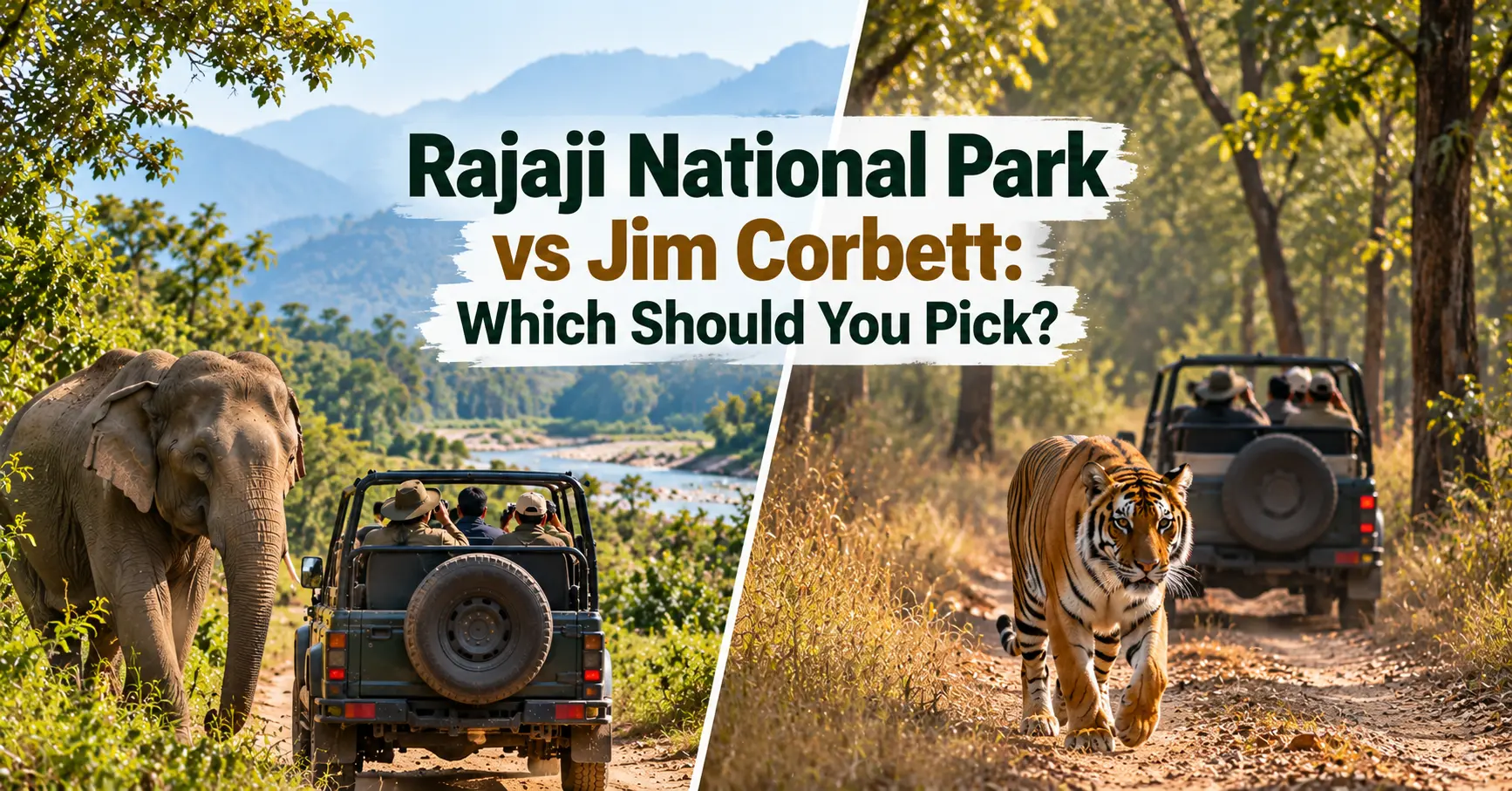
Uttarakhand has two major tiger reserves, and visitors planning a wildlife trip often can’t decide between them. Both protect Bengal tigers and Asian elephants in Shivalik forest, but they differ significantly in accessibility, crowd levels, and the kind of experience they offer. Here’s a straight comparison to help you choose.
Quick Answer
Rajaji National Park is better if you want an accessible, less-crowded tiger reserve close to Haridwar and Rishikesh, doable as a half-day trip with no overnight stay needed. Jim Corbett National Park is better if tiger sighting probability is your top priority and you don’t mind a longer drive, higher costs, and a much more competitive, crowded safari experience.
Rajaji vs Corbett: Side-by-Side Comparison
| Factor | Rajaji National Park | Jim Corbett National Park |
|---|---|---|
| Established | 1983 (48th Tiger Reserve, 2015) | 1936 (India’s first national park) |
| Total area | 820 sq km | 1,288 sq km (with buffer) |
| Bengal tigers | 50+ | 260+ |
| Asian elephants | 500+ | 600+ |
| Distance from Delhi | ~230 km (Chilla gate) | ~250–290 km (depending on zone) |
| Nearest towns | Haridwar (8 km), Rishikesh (20 km) | Ramnagar (main gateway) |
| Crowd level | Low to moderate | High, especially Dhikala zone |
| Entry fee (Indian) | ₹150 | Varies by zone, generally higher |
| Safari zones | 6 (Chilla, Motichur, Ranipur, Mohand, Jhilmil, Gohri) | 5+ zones (Dhikala, Bijrani, Jhirna, Dhela, Durga Devi) |
| Booking difficulty | Moderate — book 7 days ahead in peak season | High — online slots sell out weeks in advance |
| Overnight stay required | No, easily done as a day trip | Often yes, especially for Dhikala core zone |
| Best for | Accessible day-trip safaris, birding, elephants | Highest tiger sighting probability |
Distance and Accessibility
This is where Rajaji has a clear edge. Rajaji’s Chilla gate sits just 8 km from Haridwar and 20 km from Rishikesh — both major pilgrimage and tourism hubs with excellent rail, road, and air connectivity via Dehradun’s Jolly Grant Airport (35 km away). You can land in Dehradun, do a morning safari, and be back in Rishikesh for lunch.
Corbett’s main gateway, Ramnagar, is roughly 250–290 km from Delhi and doesn’t sit near an existing tourist circuit the way Rajaji does. Most Corbett visitors plan their trip specifically around the park rather than adding it onto a Haridwar-Rishikesh itinerary.
Tiger Sighting Probability
Corbett wins decisively here. With an estimated 260+ tigers across a larger, more established reserve, Corbett has one of India’s highest tiger densities and correspondingly higher sighting rates, particularly in the Dhikala and Bijrani zones. Rajaji, with 50+ tigers, offers real but less frequent sighting chances — Chilla zone has the best odds within Rajaji, especially on morning safaris near the Ganga.
If your single priority is maximizing the chance of seeing a wild tiger, Corbett is the stronger bet. If you’re open to a broader wildlife experience — strong elephant sightings, leopards, and excellent birdlife — Rajaji delivers a more well-rounded outing.
Is Rajaji Part of Corbett Tiger Reserve?
No — this is a common misconception. Rajaji is a separate, independently designated Tiger Reserve, declared India’s 48th Tiger Reserve in April 2015 under Project Tiger. It is not administratively part of Corbett. However, the two reserves are connected through the broader Rajaji-Corbett Elephant Reserve landscape, which supports elephant movement between the two forests. They are managed separately by the Uttarakhand Forest Department with different gates, permits, and safari booking systems.
Cost Comparison
Rajaji is generally the more affordable option. Indian adult entry is ₹150, with a private jeep costing ₹3,000 plus a ₹1,000 guide fee — working out to roughly ₹800–₹1,000 per person for a full jeep. Corbett’s core zones, especially Dhikala, often carry higher permit costs and require booking well in advance through a more competitive portal, which can also mean paying premium rates for last-minute availability.
Crowd Levels
Rajaji stays noticeably less crowded. Its safari zones don’t see the volume of vehicles that Corbett’s popular zones do, especially Dhikala and Bijrani during peak December–February weekends. If you’re looking for a quieter, more personal wildlife experience without convoys of jeeps at every waterhole, Rajaji is the better choice.
Which is Closer to Rishikesh?
Rajaji, without question. At just 20 km from Rishikesh (12 km to the Mohand zone specifically), Rajaji is easily reachable as a half-day excursion from anywhere in the Rishikesh-Haridwar belt. Corbett requires a dedicated multi-hour drive and is not a practical add-on to a Rishikesh trip.
Which Should Families Choose?
Families traveling with young children or elderly members will likely find Rajaji more convenient — shorter travel time, no mandatory overnight stay, and zones like Motichur that are specifically known for frequent, relatively easy elephant sightings in dense Sal forest. Corbett’s core zones, by contrast, often require an overnight stay inside or near the park, which adds cost and logistics.
Which Should Serious Wildlife Photographers Choose?
Photographers chasing tiger images will lean toward Corbett given its higher tiger density. But for birdwatching photography, Rajaji’s Mohand zone — with 200+ recorded bird species — is genuinely one of North India’s better birding destinations, arguably a stronger niche pick than Corbett for that specific interest.
Conclusion
Neither park is objectively “better” — the right choice depends on what you’re optimizing for. Choose Rajaji if you want accessibility, lower crowds, lower cost, and a half-day trip from Haridwar or Rishikesh without overnight logistics. Choose Corbett if maximizing your chance of a tiger sighting is the non-negotiable priority and you’re willing to plan further ahead, pay more, and deal with heavier crowds. Many Uttarakhand travelers end up doing both on separate trips, since the two parks offer genuinely different experiences rather than a simple upgrade/downgrade of each other.
Frequently Asked Questions
Is Rajaji National Park better than Jim Corbett?
It depends on priorities. Rajaji is more accessible, less crowded, and cheaper; Corbett has significantly higher tiger density and sighting probability. Neither is universally “better” — they suit different kinds of trips.
Is Rajaji National Park part of Jim Corbett?
No. Rajaji is a separate, independently designated Tiger Reserve (India’s 48th, declared in 2015) with its own gates, permits, and management by the Uttarakhand Forest Department. It is connected to Corbett only through the broader elephant reserve landscape, not administratively.
Which national park is closer to Rishikesh, Rajaji or Corbett?
Rajaji is far closer — about 20 km from Rishikesh (12 km to the Mohand zone), versus Corbett’s roughly 250+ km distance from Delhi and a multi-hour drive from Rishikesh.
Is Rajaji safari less crowded than Corbett safari?
Yes, generally. Rajaji safari zones see noticeably fewer vehicles than Corbett’s popular zones like Dhikala and Bijrani, especially during peak weekends in December and January.
Which has more tigers, Rajaji or Corbett?
Corbett has significantly more tigers — an estimated 260+, compared to Rajaji’s 50+. Corbett is one of India’s highest tiger-density reserves.
Do I need to stay overnight for a Corbett or Rajaji safari?
Rajaji safaris can be done as a half-day trip with no overnight stay required, since it’s close to Haridwar, Rishikesh, and Dehradun. Corbett’s core zones, especially Dhikala, often require an overnight stay inside or near the reserve.
About the Author
Veeru Negi is a local safari guide with over 15 years of experience navigating the forests, wildlife trails, and zones of Rajaji National Park. Having grown up near the park’s boundary, Veeru has an intimate knowledge of animal movement patterns, seasonal behavior, and the best times to spot tigers, elephants, and leopards across zones like Chilla, Motichur, and Kansro. He has guided hundreds of wildlife enthusiasts, photographers, and families through safe, memorable safari experiences, and regularly shares his on-ground expertise to help visitors plan smarter trips to Rajaji.
Learn more about Veeru →